
PSS vs GLIDE Shaft Seal
GLIDE and PSS solve the same problem in different ways. The GLIDE system is a self-lubricating double lip seal in a machined non-metallic housing, made in Michigan, with the larger ULTRA model carrying a spare seal behind a six-screw cover. The PSS is a mechanical face seal that seals at its own carbon and stainless faces rather than on the shaft. For Australian buyers the practical difference is often parts: GLIDE publishes no Australian distributor, while PSS sizes and maintenance kits sit on our shelf in Mornington.
PSS and GLIDE side by side
Published manufacturer figures only. Where a maker does not publish a figure, the table says so rather than guessing.
Seal type
PSS Shaft Seal
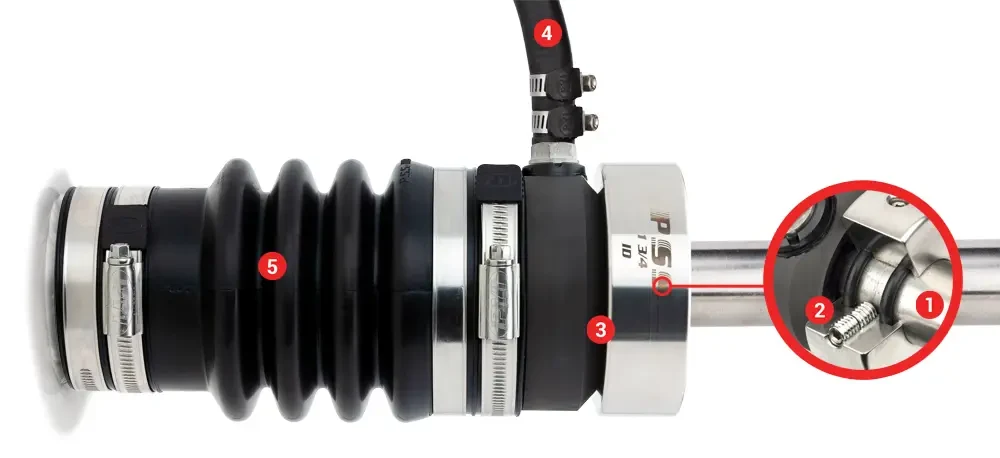
Mechanical face seal - stationary carbon stator against a rotating 316L stainless rotor on a compressed bellow
GLIDE
Self-lubricating double lip seal riding directly on the shaft, in a one-piece machined GLIDE-100 polymer housing with an integral bearing surface
What actually seals
PSS Shaft Seal
The lapped carbon and stainless faces. The rotor's O-rings sit statically on the shaft
GLIDE
The shaft surface, via the twin lips. GLIDE states the seal "will not harm the shaft over time, even if it is run dry" - a manufacturer claim with no published test data behind it
Shaft size range
PSS Shaft Seal
Type A: 3/4" to 3-3/4" (20-95 mm), in both imperial and metric sizes. Type B and C continue to 8" on special order
GLIDE
3/4" to 4.0" across seals, bearings and rudder sleeves. GMSS covers 0.750"-1.500"; GLIDE ULTRA covers 1.000"-4.000" in six bands. Imperial sizes only are published
Water feed
PSS Shaft Seal
Vent line under about 12 knots; a plumbed feed above that, plus three published exceptions
GLIDE
Supplied water-fed - both kits ship with a water supply line and fittings. GLIDE describes the water as ensuring "a properly lubricated bearing surface when a slight load occurs due to difficult alignment"
Spare seal on board
PSS Shaft Seal
No in-service spare; a maintenance kit is carried as a spare part
GLIDE
GLIDE ULTRA carries a second lip seal in the housing, reached by removing six cover screws with no need to remove the primary seal. The smaller GMSS is not published with this feature
Scheduled replacement
PSS Shaft Seal
Bellow every 6 years regardless of condition; inspect at least 6-monthly
GLIDE
No seal replacement interval or service life is published
Published operating limits
PSS Shaft Seal
10,000 shaft RPM; temperature 5F to 225F (-15C to 107C) for Type A
GLIDE
Working temperature up to 245F+ (about 118C). No maximum shaft RPM is published
Installation
PSS Shaft Seal
Bellow compressed to the published figure for the size; set screws are single-use
GLIDE
GLIDE states every seal "must be installed with the provided install tool" for warranty cover
Warranty
PSS Shaft Seal
3 years from first use or shipment, original purchaser only
GLIDE
GLIDE's product pages head the warranty as 4 years (GMSS) and 5 years (ULTRA), while the warranty text on both pages reads "up to four years from the date of the initial sale when used in a non-commercial marine application"
We quote GLIDE's warranty body text rather than the headings, and note that the published term covers non-commercial use.
Australian support
PSS Shaft Seal
Luxfords is an authorised PSS dealer holding one of Australia's largest ranges in stock.
GLIDE
GLIDE publishes no Australian distributor or dealer list. One Australian retailer lists the GMSS in 1", 1-1/8" and 1-1/4" only; other sizes are a direct order from Michigan, shipped FOB origin
| Specification | PSS Shaft Seal | GLIDE |
|---|---|---|
| Seal type | Mechanical face seal - stationary carbon stator against a rotating 316L stainless rotor on a compressed bellow | Self-lubricating double lip seal riding directly on the shaft, in a one-piece machined GLIDE-100 polymer housing with an integral bearing surface |
| What actually seals | The lapped carbon and stainless faces. The rotor's O-rings sit statically on the shaft | The shaft surface, via the twin lips. GLIDE states the seal "will not harm the shaft over time, even if it is run dry" - a manufacturer claim with no published test data behind it |
| Shaft size range | Type A: 3/4" to 3-3/4" (20-95 mm), in both imperial and metric sizes. Type B and C continue to 8" on special order | 3/4" to 4.0" across seals, bearings and rudder sleeves. GMSS covers 0.750"-1.500"; GLIDE ULTRA covers 1.000"-4.000" in six bands. Imperial sizes only are published |
| Water feed | Vent line under about 12 knots; a plumbed feed above that, plus three published exceptions | Supplied water-fed - both kits ship with a water supply line and fittings. GLIDE describes the water as ensuring "a properly lubricated bearing surface when a slight load occurs due to difficult alignment" |
| Spare seal on board | No in-service spare; a maintenance kit is carried as a spare part | GLIDE ULTRA carries a second lip seal in the housing, reached by removing six cover screws with no need to remove the primary seal. The smaller GMSS is not published with this feature |
| Scheduled replacement | Bellow every 6 years regardless of condition; inspect at least 6-monthly | No seal replacement interval or service life is published |
| Published operating limits | 10,000 shaft RPM; temperature 5F to 225F (-15C to 107C) for Type A | Working temperature up to 245F+ (about 118C). No maximum shaft RPM is published |
| Installation | Bellow compressed to the published figure for the size; set screws are single-use | GLIDE states every seal "must be installed with the provided install tool" for warranty cover |
| Warranty | 3 years from first use or shipment, original purchaser only | GLIDE's product pages head the warranty as 4 years (GMSS) and 5 years (ULTRA), while the warranty text on both pages reads "up to four years from the date of the initial sale when used in a non-commercial marine application" |
| We quote GLIDE's warranty body text rather than the headings, and note that the published term covers non-commercial use. | ||
| Australian support | Luxfords is an authorised PSS dealer holding one of Australia's largest ranges in stock. | GLIDE publishes no Australian distributor or dealer list. One Australian retailer lists the GMSS in 1", 1-1/8" and 1-1/4" only; other sizes are a direct order from Michigan, shipped FOB origin |
Figures from GLIDE Bearings and Seal Systems' own product pages and the PSS Shaft Seal catalogue and Type A installation instructions, checked August 2026. Where a maker does not publish a figure, this table says so rather than estimating.
When GLIDE makes sense
- You run an inboard ski or wake boat in the sizes GLIDE is built around. That is the segment the GMSS was developed and validated in, and it is a purpose-designed product for it.
- You want a spare seal you can reach without hauling out. On the GLIDE ULTRA the spare sits behind a six-screw cover and does not require removing the primary seal - a genuinely good piece of design.
- You want nothing metallic in the housing. The GLIDE-100 billet housing is non-metallic with stainless hardware, which some owners prefer in the shaft log.
- You already have one fitted and it is dry. There is no engineering reason to change a working seal.
When PSS is the better choice
- You want parts in Australia. This is the honest headline: Luxfords is an authorised PSS dealer holding one of Australia's largest ranges in stock. GLIDE publishes no Australian distributor, and the one Australian retail listing we can find covers three ski-boat sizes, so anything larger is a direct order from Michigan on FOB-origin terms.
- Your shaft has wear on it. A face seal does not depend on the shaft's surface condition to seal, where a lip seal does.
- You want published limits to design around. PSS publishes a 10,000 RPM ceiling, a temperature range and a maintenance interval; GLIDE publishes a working temperature but no RPM limit and no replacement interval.
- The boat works for a living. The PSS warranty makes no recreational-only distinction, while GLIDE's published warranty text covers non-commercial marine use.
- You need metric sizing. PSS Type A is published in both imperial and metric; GLIDE publishes imperial sizes only.
Why the sealing surface matters
Both the GLIDEsystem and the PSS keep the bilge dry. The difference is where the wear happens. A lip seal presses a flexible lip against the spinning shaft, so the shaft's own surface is part of the seal - which is why lip seal guidance talks about polishing the shaft or moving to a fresh section of it.
The PSS moves that job off the shaft entirely. A stationary carbon stator runs against a rotating 316L stainless rotor, and the rotor's O-rings sit statically on the shaft and turn with it. Nothing rubs the shaft, so a shaft already scored by old packing or a previous seal is usually still fine to seal on, and the carbon - rated to 500F - survives the brief dry run that would finish a rubber lip.
It is not a free lunch. The bellow is a consumable on a published six-year clock and replacing it means a haul-out, and above about 12 knots the seal needs a plumbed water feed. Those are the trade-offs, and they are on the table above.
PSS vs GLIDE: common questions
What exactly is a GLIDE shaft seal?
It is a dripless shaft seal made by GLIDE Bearings and Seal Systems (MSSB LLC) of Alto, Michigan. It uses a self-lubricating double lip seal running on the shaft inside a machined GLIDE-100 polymer housing, and comes in two lines: the GMSS for smaller inboards from 0.750 to 1.500 inch, and the GLIDE ULTRA from 1.000 to 4.000 inch for larger boats kept in the water. It is a lip seal system, where the PSS is a mechanical face seal.
Can I buy GLIDE seals and spares in Australia?
Partly. GLIDE publishes no Australian distributor or dealer list, and the only Australian retail listing we could find covers the GMSS in 1 inch, 1-1/8 inch and 1-1/4 inch. For other sizes, spares and warranty administration you are dealing with Michigan directly, with freight and transit risk on the buyer. That is a fact about distribution rather than a criticism of the product - but if you are the sort of owner who wants a part this week, it matters.
Can I replace a GLIDE seal with a PSS seal?
In most cases yes. Both clamp to the stern tube, so the conversion is a haul-out with the coupling removed and the shaft normally staying in the boat. What we need first is your shaft diameter, stern tube OD and how much stern tube you have exposed - the PSS is sized on all three. Send those through and we will confirm the exact part number before you book the yard.
Is GLIDE's warranty really five years?
It depends which part of their page you read, so we will quote it exactly rather than pick a number. GLIDE's product pages carry headings of 4 years for the GMSS and 5 years for the ULTRA, while the warranty body text on both pages says "up to four years from the date of the initial sale when used in a non-commercial marine application". It also requires the supplied install tool to have been used. The PSS warranty is three years from first use or shipment to the original purchaser, with no recreational-only limitation.
Which seal is better for a commercial or charter boat?
On published terms, the PSS. GLIDE's warranty text covers non-commercial marine use, so a hire boat, charter vessel or workboat sits outside the stated term. PSS's three-year warranty makes no such distinction, and the manufacturer publishes commercial anecdotes of 40,000-plus engine hours on original components. Whichever way you go, tell us how the boat earns its keep and we will spec it properly.
Is a face seal or a lip seal the better technology?
Neither is universally better - they fail differently and they suit different boats. A lip seal is simple, compact and lets you carry a spare you can change afloat, but it wears against the shaft and its life depends on the shaft's surface. A face seal moves the wear surface off the shaft onto lapped carbon and stainless, tolerating worn shafts and brief dry running, but its bellow is a consumable on a fixed six-year clock and changing it means hauling out.
Changing over from GLIDE?
Send us your shaft diameter, stern tube OD and how much stern tube you have exposed - that is all we need to confirm the exact PSS part and quote it, usually from stock.
Luxfords is an authorised PSS dealer holding one of Australia's largest ranges in stock — most shaft and stern tube combinations are on the shelf, so we can usually have you sorted straight away.
(03) 5973 6444Get a PSS seal quote
GLIDE is a trademark of its respective owner and is used here only to identify the product being compared. Luxfords is not affiliated with, endorsed by or sponsored by GLIDE.