
Cutlass Bearings
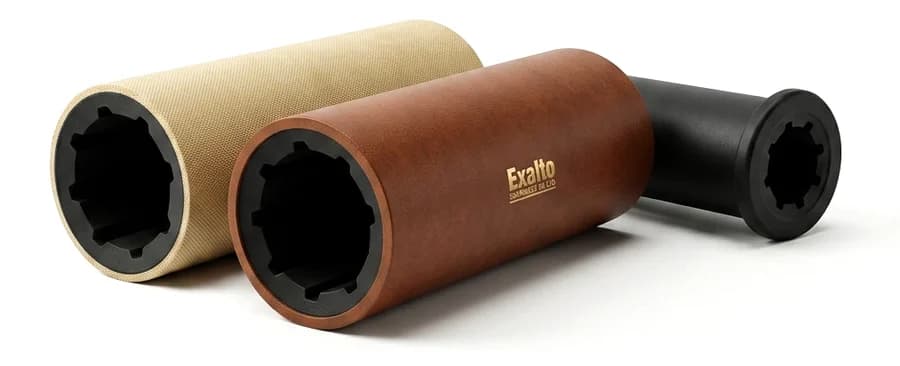
The water-lubricated rubber bearing your propeller shaft rides on. We carry 213+ genuine Exalto sizes — British-made in Derby — across phenolic, brass, GRP and all-rubber shells, in imperial and metric, for shafts from 3/4″ to 4″ (20–100 mm). Specials made to order.
Why your shaft rides on rubber and water
A cutlass bearing looks simple — a fluted nitrile rubber sleeve inside a hard shell — but the physics is elegant. Water flows along the grooves, and once the shaft spins, the soft rubber lets a thin water film build between shaft and bearing: the shaft rides on water, not rubber. Friction is minimal, nothing needs greasing, and the bearing cools itself.
The grooves earn their keep in dirty water too. Sand and grit that would score a hard bearing press momentarily into the soft rubber and flush straight out with the water flow — the reason rubber has outlasted every "harder" alternative in this job for a century.
The catch: it only works with water flowing. A blocked groove, an anode clamped hard against the bearing end, or a dry start turns elegance into squealing wear — which is why our wear guide spends as much time on what kills bearings as on how to spot a worn one.
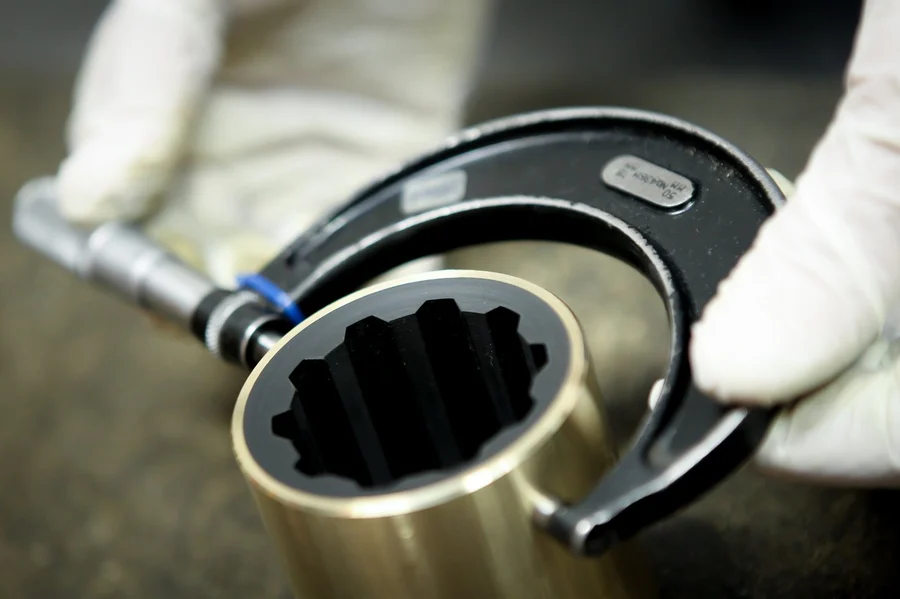
The fluted bore: water flows along the grooves to lubricate, cool and flush grit.
Four shells, one rule
Every Exalto bearing wears the same nitrile rubber inside — the shell is what you choose, and the golden rule is galvanic: never put a brass shell in a steel or aluminium housing.
Phenolic80 sizes
Fabric-reinforced phenolic resin shell, nitrile rubber lining
The everyday default — immune to galvanic corrosion, suits bronze, steel and GRP housings alike
Brass49 sizes
Naval brass shell, nitrile rubber lining
Structurally the strongest shell — the choice for worn or slightly oversize housings and traditional bronze fittings
GRP75 sizes
Glass-reinforced polyester shell, nitrile rubber lining
The best alternative to brass for steel and aluminium stern tubes — and ideal for bonding into fibreglass tubes
All-rubber flanged9 sizes
Moulded nitrile rubber with integral mounting flange — no hard shell
Production yachts (Jeanneau, Beneteau and similar) whose sterngear is designed around a flanged rubber bearing
Measuring a worn bearing lies to you. The rubber deflects under a caliper and the bore has worn anyway — measure the shaft itself (three places, take the largest) and the housing bore (both ends), and match the original length. Our measuring guide walks through it.
Cutlass bearing guides
Bearing finder
Pick your shaft size and housing bore — see every matching Exalto bearing across all four shell materials.
Read moreMeasuring guide
The three measurements that identify any bearing, how to take them properly, and the imperial-vs-metric traps.
Read moreWear, inspection & replacement
The wiggle test, what the clearances should be, what kills bearings early, and how replacement actually works.
Read moreChoosing the shell material
Phenolic, brass, GRP or all-rubber — and the galvanic rule that decides it for steel and aluminium boats.
Read moreCutlass bearing FAQs
What is a cutlass bearing and what does it do?
It's the water-lubricated rubber bearing that supports your propeller shaft where it exits the boat — in the strut (P-bracket) or stern tube. A fluted nitrile rubber sleeve sits inside a brass, phenolic or GRP shell; water flows along the grooves to lubricate and cool the rubber, and the spinning shaft rides on a thin film of water rather than on the rubber itself. The grooves also flush grit through before it can score the shaft — the reason soft rubber outlasts hard bearing materials in this job.
How do I know when my cutlass bearing needs replacing?
With the boat hauled out, grab the shaft (or propeller) beside the bearing and lever it firmly up-down and side-to-side. A barely perceptible movement is normal — the bearing runs on designed clearance — but visible wiggle or an audible clunk means it's due. Other signs: vibration under way that grows with speed, a rumble through the hull, or a squeal or chirp at low revs. One caution: a misaligned shaft can bind in the bearing and pass the wiggle test while wearing rapidly — uneven wear (top at one end, bottom at the other) is the tell-tale.
What three measurements do I need to order a bearing?
Shaft diameter, bearing outside diameter (the housing bore), and length. Measure the shaft itself in three places and use the largest reading, and the housing bore at both ends — never measure the worn bearing's inside diameter, because the rubber deflects and reads falsely. Watch the unit system: imperial sizes step in 1/8″ and metric in 5 mm, and a 1″ (25.4 mm) shaft is not interchangeable with a 25 mm one.
Why is the bearing four times as long as the shaft diameter?
It's a classification-society rule for the water-lubricated bearing nearest the propeller: rubber carries only a light load per unit area, so the bearing needs length to spread the load and to build its hydrodynamic water film. That's why catalogue sizes run 1″ × 4″, 25 × 100 mm, 1-1/4″ × 5″ and so on. When replacing, match the original length — never fit a longer bearing than the housing was designed for.
Which shell material should I choose?
Phenolic is the everyday default — corrosion-proof and compatible with any housing. Brass is the strongest shell and suits bronze fittings or slightly worn housings, but must never go into a steel or aluminium stern tube (galvanic corrosion). GRP is the pick for steel and aluminium tubes and for bonding into fibreglass — it's the speciality Exalto UK credits to Luxfords. All-rubber flanged bearings suit production yachts designed around them.
What kills cutlass bearings early?
Water starvation tops the list — anodes clamped hard against the bearing end, antifouling or barnacles blocking the grooves, or a stern-tube bearing without proper water feed. After that: shaft misalignment (the most common cause of premature wear), fishing line worked into the bearing, grit in silty water, and corrosion of a brass shell in the wrong housing. A correctly fed, aligned bearing routinely lasts many years of normal use.
Can I replace a cutlass bearing myself?
With the boat hauled, yes — it's a well-documented job. Strut bearings can often be changed with a proper puller without pulling the shaft; stern-tube bearings usually need the shaft withdrawn. The rules that matter: remove the set screws first, press the new bearing in gently (never hammer it — shock breaks the rubber-to-shell bond), use only water-soluble soap or glycerine as lubricant (petroleum products clog the grooves), and refit set screws with thread-locker so they bear on the shell, never the rubber. Most owners hand it to a shipwright at antifoul time.
Is it 'cutlass' or 'cutless' bearing?
Both spellings are everywhere, and there's history behind it: ‘Cutless’ is the original trade name — the story goes the rubber bearing ‘cut less’ into shafts than the lignum vitae it replaced — and remains a registered trademark (now of Duramax Marine) in the United States. Australia and the UK long ago settled on ‘cutlass’, like the sword, as the generic spelling, and Exalto themselves use it. Either way, it's the same water-lubricated rubber shaft bearing.
Need a bearing identified or supplied?
Send your measurements — or a photo of the old bearing with a tape measure across it — and we'll confirm the exact Exalto part and respond promptly with availability.
Three measurements identify any cutlass bearing: shaft diameter, outside diameter and length. Send what you have — even a photo of the old bearing — and we'll confirm the right Exalto part.
(03) 5973 6444Enquire about cutlass bearings
A photo of the old bearing's end (showing shell thickness) with a tape across it, plus the shaft size, usually pins down the part. Sends to sales@luxfords.com.au.