
Replacing an impeller, properly
Twenty minutes, once a year, and your engine's cooling system starts the season new. Here's the procedure as the pump makers write it — and the two habits that separate a good change from a future overheat.
Annual. The makers all agree.
Johnson's identification guide opens with it: "change to a new impeller every year… the impeller is a very important security device." Jabsco: replace all impellers at least once every year, or sooner depending on duty. Sherwood goes further with a duty schedule — annually for pleasure boating, every six months for high-RPM or silty water, every three for severe commercial work.
The logic is brutal economics: the rubber ages whether you run it or not, a failed impeller takes the cooling system down with it, and the impeller is the cheapest part in that chain. Sherwood adds a lay-up tip worth stealing: remove the impeller for winter storage and keep it somewhere cool and dark, so it doesn't take a set — or bond itself to the housing.
The change, step by step
Seacock off, cover off
Close the raw water seacock, remove the pump end cover, and keep the screws and o-ring or gasket somewhere safe — they go missing more often than impellers fail.
Pull the old one
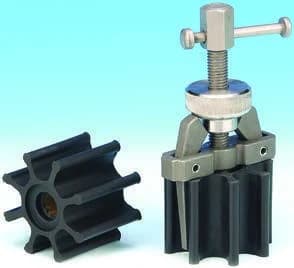
Impeller puller or channel-lock pliers on the hub — never screwdrivers levering on the pump face. Sherwood's threaded-insert impellers jack out with the Sherwood puller; keyed pumps: retrieve the key.
Read it, then count it
Diagnose the failure mode (dry run, cavitation, abrasion, chemical attack) — and count every vane and fragment. Missing pieces are downstream in the oil cooler or heat exchanger inlet. Find them all.
Lube and twist the new one in
Non-petroleum lubricant only (glycerine, soapy water, silicone). Push and twist in the direction of rotation; align keyways gently — never force. Dab of lube to hold the o-ring, cover on, seacock OPEN, then watch the exhaust for water.
The 20-second rule:the pumped water is the impeller's only lubrication — Jabsco allows no more than 20 seconds of dry running. If the engine ever ran with the seacock closed or the strainer blocked, treat the impeller as damaged even if it looks perfect.
Identifying an unknown impeller
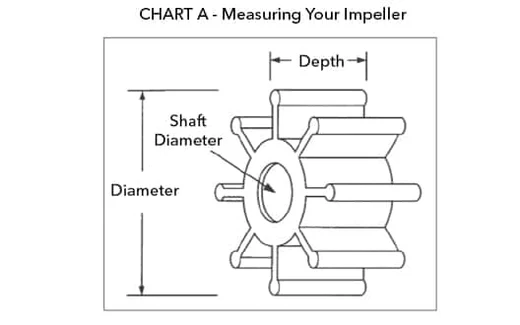
Five things identify almost any impeller, straight from Jabsco's identification method:
- Outside diameter
- Width (depth) of the rubber body
- Shaft or bore diameter
- Number of blades
- Drive type — pin, key, flat, spline, or Sherwood's thru-key / threaded-insert styles
Then pick the material: neoprene for engine cooling, nitrile for oily or bilge water. Punch the numbers into the finder — or send photos with a ruler in frame.
Replacement FAQs
Which way should the vanes bend when I fit the new impeller?
With the direction of rotation — fit with a pushing, twisting motion in the pump's rotating direction (Johnson's wording), and Sherwood says to make sure the blades bend the same way as they did on the old impeller. Forcing an impeller straight on, or against rotation, folds vanes the wrong way and costs flow from day one. Jabsco's tip if an impeller has taken a slight set in storage: refit it to rotate the opposite direction.
What lubricant goes on a new impeller?
Non-petroleum only: glycerine, soapy water, silicone or the pump maker's own impeller lubricant (Johnson 01-46968, Jabsco's impeller grease). Sherwood is blunt about the rest — petroleum-based fluids damage the impeller. Never grease, oil, fuel or petroleum jelly; the rubber pays for it.
Do I need a special puller?
For small impellers, channel-lock pliers and patience usually work (never screwdrivers against the pump face — Jabsco specifically warns they damage the sealing surface). Purpose-made pullers exist for a reason though: Jabsco's removal tools cover up to 4-1/2 inch impellers, Johnson's 'Impuller' suits its F-series, and Sherwood's threaded-insert impellers are designed to be jacked out with the Sherwood puller. We stock them.
What does the old impeller tell me?
Everything, if you read it: glazed, cracked faces with torn vanes = it ran dry; missing chunks from vane tips with pitting = cavitation from a starved inlet; worn tips with a cam imprint = sand or silt; a swollen, sticky impeller wider than its hub = oil or diesel attack (wrong material — use nitrile); vanes bent at rest = permanent set from storage. Fix the cause, or the new impeller inherits it.
Impeller, kit and puller - one quote
Send the part number or the engine — we'll match the impeller and the o-ring or kit it should come with, and add a puller if you want the job to take ten minutes instead of thirty. Spares for the spares kit, too.