
Living with a PSS seal
No packing to tighten, no drip rate to tune — but "low maintenance" isn't "no maintenance." The PSS routine is three habits: burp it at launch, look at it twice a year, and renew the bellow every six years. Here's each one, straight from the official guidance.
The three habits
Burp it at launch
Every relaunch / after ~3 months idle
Air trapped at the faces makes the seal run dry — the cause of that startling squeal. Before starting the engine after a haul-out or long lay-up, ease the carbon aft until water flows, then release. A properly fitted vent line or water feed does this automatically, but checking costs nothing.
Look at it twice a year
At least every 6 months
Check the bellow for cracks, splits or brittleness, the hose clamps for corrosion, the vent or feed line for kinks and growth, and the faces for drips at rest. The carbon has a machined chamfer at its face — it's the built-in wear indicator; if it's gone, call us.
New bellow every 6 years
Maximum — regardless of appearance
The nitrile bellow is the spring that loads the seal and part of the hull's watertight boundary. PSS requires replacement at least every six years even if it looks perfect. One maintenance kit, one haul-out, and the seal is essentially new.
The maintenance kit - carry one aboard
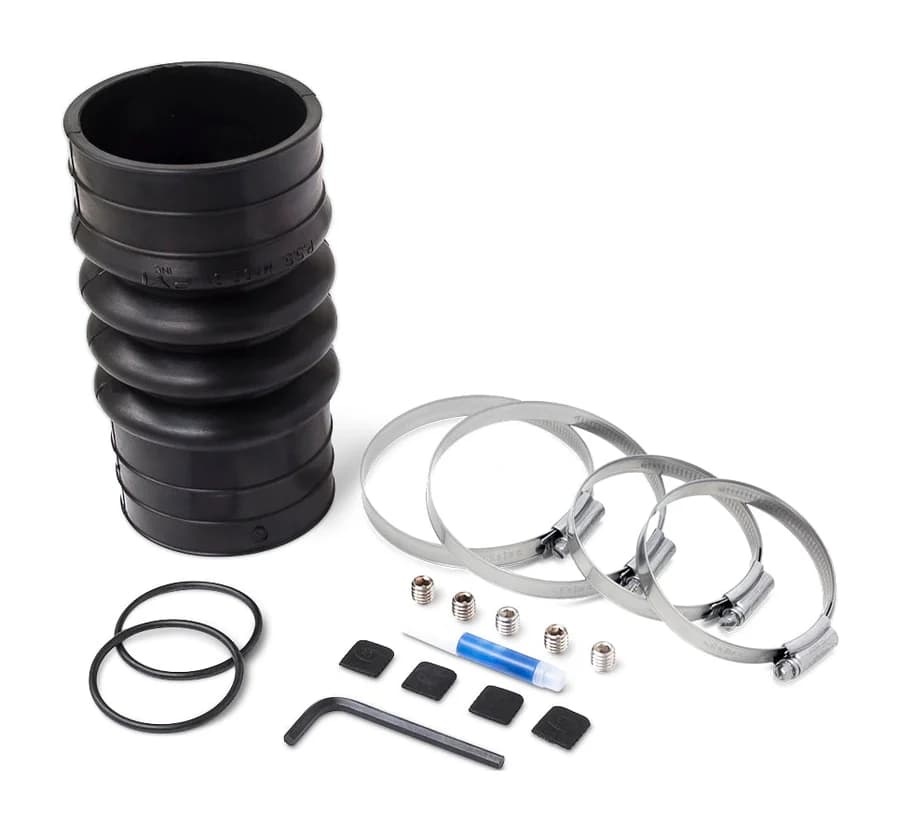
Everything the six-year service consumes, in one genuine PSS box: a new nitrile bellow, two rotor O-rings, five cup-point set screws (they bite once — never reuse them), four hose clamps, thread-locker and the Allen key. Even between services it's cheap insurance to have aboard.
- Kits in stock for all common sizes — tell us your shaft diameter
- Spare carbons, rotors, bellows and clamps also available individually
- Vent fittings and water-injection T-kits on the shelf
- Fitting requires a haul-out — most owners pair it with antifouling
The things that kill seals
Running dry
A high-pitched squeal means no water at the faces. The carbon won't melt like a plastic seal, but prolonged dry running overheats and damages it — fix the vent or feed, don't just wait for the noise to stop.
Petroleum and chemicals
Oil, grease, fuel, silicone sprays and harsh cleaners attack nitrile. Keep them off the bellow and O-rings — including during engine winterising.
Blocked water feed
On water-injected boats, scale or growth in the feed line starves the seal at speed. Check flow as part of the six-monthly look.
Tired clamps and screws
Replace hose clamps at any sign of corrosion, and never reuse set screws — the maintenance kit includes fresh ones for a reason.
Warranty:the PSS seal carries a three-year manufacturer's warranty from date of first use or shipment, claimed through an authorised dealer with proof of purchase — keep your invoice with the ship's papers. Correct installation and maintenance keep it valid.
Maintenance FAQs
What's in a PSS maintenance kit?
The genuine Type A kit contains a new nitrile bellow, two rotor O-rings, five set screws, four hose clamps, thread-locker and an Allen key — everything consumed in a bellow change. Fitting it requires a haul-out and removing the shaft coupling, so most owners schedule it with antifoul time. We keep kits for all common sizes in stock.
Why replace the bellow if it looks fine?
Nitrile ages from heat, ozone and chemical exposure whether or not cracks show on the surface — and the bellow is both the spring that loads the seal faces and a piece of the watertight boundary below the waterline. PSS's instruction is unambiguous: replace it at least every six years regardless of appearance. Between changes, inspect at least every six months for cracks, splits or brittleness.
There's a fine mist coming off the seal - is it failing?
During the first hour of running after installation, a fine mist and a little black carbon dust are normal break-in and stop on their own. After break-in, misting usually means the bellow needs another 1/4" of compression, and recurring black dust suggests misalignment or wear worth investigating. Drips at rest are usually debris between the faces — part the faces briefly with a clean rag to flush them clean.
How do I winterise or lay up a boat with a PSS seal?
Keep petroleum products, antifreeze overspray and corrosive chemicals away from the bellow and faces — that includes engine winterising fluids. Avoid ozone generators aboard, and note that venting battery acid vapour accelerates bellow ageing. After roughly three months idle, or at the first launch of the season, burp the seal before starting the engine.
Due a bellow - or just want spares aboard?
Tell us your shaft size and we'll pull the right maintenance kit from the shelf, with any spare carbons, clamps or vent fittings you want with it.
Luxfords is an authorised PSS dealer holding one of Australia's largest ranges in stock — most shaft and stern tube combinations are on the shelf, so we can usually have you sorted straight away.
(03) 5973 6444