
Wet exhaust design rules
Every flooded engine traces back to a rule on this page. These are the numbers from Vetus' installation manual and catalogue — the heights, distances and capacities that keep water moving one way only.
The seven rules that matter
Hose: never smaller than the outlet
Match the engine's exhaust outlet and check the power table — at 0.1 bar allowed back pressure, 40 mm carries 18 kW, 60 mm carries 39 kW, 90 mm carries 89 kW. The hose must run with a continuous downward slope from injection point to waterlock.
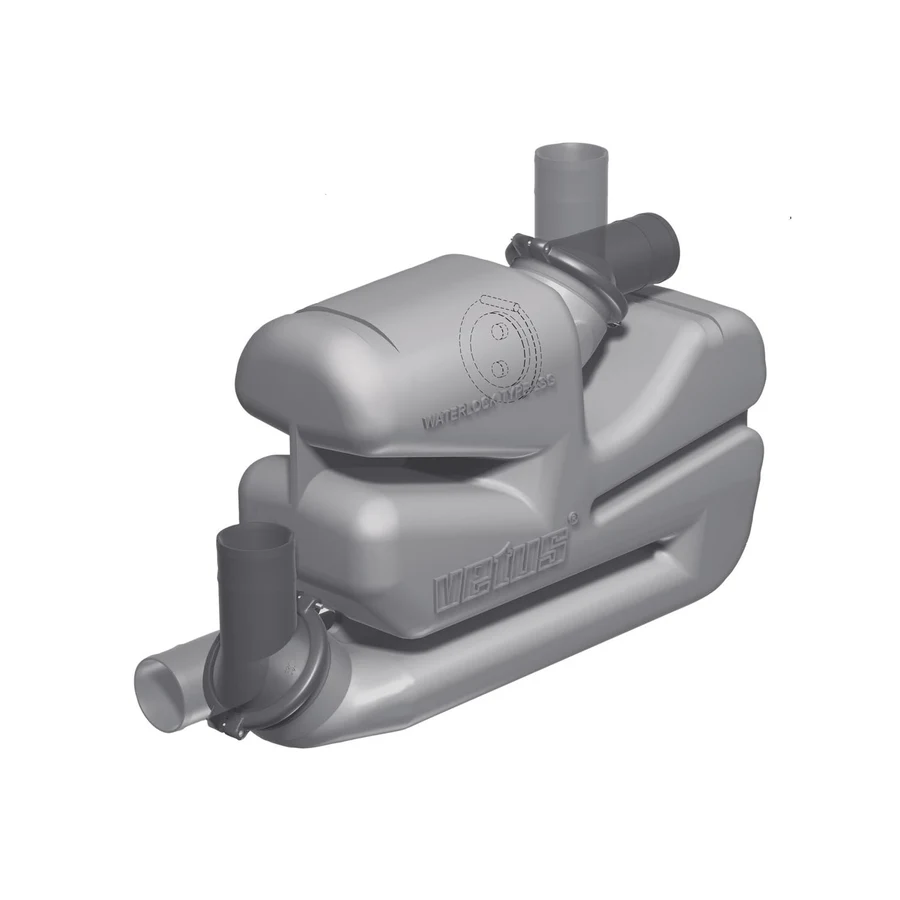
Waterlock below the outlet
Always lower than the engine's exhaust outlet, as vertical as possible, firmly strapped. The inlet sits below the injection bend, and the underside of the cooling-water outlet must clear the highest point of the waterlock by at least 5 cm under all sailing conditions, heel included.
Capacity: catch every drop
The waterlock must hold all the water that drains back at shutdown. Vetus' calculation assumes 25% of the hose volume is standing water and doubles it for margin — long runs need the LSL's extra capacity.
Gooseneck: ~45 cm, max 150 cm
Lift the hose above the waterline so the sea can't backfill — about 45 cm of high point, never more than 150 cm above the waterlock's underside (back pressure), with that section no longer than 300 cm. Mount it as directly above the waterlock as possible.
Siphon break at 15 cm
If the water injection point is below — or less than 15 cm above — the waterline (heeled counts), fit an air vent in the hose between engine and injection point, at least 40 cm above the waterline. This is the rule that saves engines.
Transom outlet ≥10 cm up
The hull outlet sits at least 10 cm above the fully-laden waterline. Transom connections with internal flaps add another layer against a following sea.
Respect back pressure
All the sizing assumes 0.1 bar allowed back pressure. Higher riser, extra bends and smaller hose all add to it; if the engine maker allows more, sizes can shift — that's a check we run with the engine's data.
Where wet exhausts go wrong
- Back-flooding at anchor or under sail — undersized waterlock or missing gooseneck; worst on sailing boats rolling engine-off
- Siphoning into a stopped engine — injection point near the waterline with no air vent (rule 5)
- Mixing elbow corrosion — hot gas meets salt water there; industry guidance puts inspection/replacement around the 3–7 year band depending on use
- Hose failure — wet exhaust hose must be reinforced, gas/heat/oil resistant and must not collapse when hot; Vetus EPDM hose is rated 100 °C continuous
- Cranking floods — repeated start attempts fill the waterlock; drain it before persisting
The gas/water separator option: on fast boats and quiet sterns, an LGS separator drops the water out below the waterline and lets the gas exit above it — also acting as the gooseneck. Worth considering at design time rather than after.
Design FAQs
Why did my engine fill with water while sailing?
The two classic routes: water siphoned through the cooling circuit because the injection point sat too close to the waterline without an air vent, or the sea pushed back up an exhaust with no (or too little) gooseneck while the boat rolled with the engine off. Both are design problems with cheap fixes — an air vent at least 40 cm above the waterline for the first, a proper gooseneck and adequate waterlock capacity for the second. Sailing boats need the most margin: Vetus calls extra waterlock capacity 'of vital importance' for a boat that rolls and pitches engine-off.
How high can the exhaust hose rise?
Vetus' limits: the highest point in the run between waterlock and transom should not exceed 150 cm above the underside of the waterlock, and the hose section from waterlock to that high point shouldn't exceed 300 cm. Every centimetre of rise adds back pressure, so the guidance is a gooseneck high point around 45 cm — enough to defeat the sea, no more than the engine needs to fight.
Can repeated starting attempts really flood the engine?
Yes — Vetus warns about it specifically. Every starting attempt injects cooling water into the exhaust, and if the engine doesn't fire, that water accumulates in the waterlock with nowhere to go. Crank long enough and it backs up to the engine. If the engine won't start after several tries, stop and drain the waterlock before continuing.
Does the waterlock have to be on the centreline below the engine?
It has to be lower than the engine's exhaust outlet and as vertical as possible — but Vetus explicitly allows mounting it 'back-to-front' beside the engine when there's no room behind, and the rotatable connections on the LP-R, LSS and NLP families exist for exactly these layouts. Strap it down firmly: a waterlock full of water is many times its dry weight.
Designing a system? Sketch it for us.
A photo or sketch with the engine model, waterline and the hose run is enough — we'll apply these rules, pick the components, and quote the lot including hose by the metre.