
Anchor chain size chart: sizes, lengths and how much to carry
Your anchor is only as good as the rode behind it. Here's how chain size follows boat length, how scope determines the length you carry, and when rope/chain beats all-chain — with chain and rope cut to exactly the length you need, by the metre.
Chain size by boat length
Short-link chain to DIN766 (or equivalent calibrated standard), hot-dip galvanised or AISI 316 stainless. Weights per metre are what our selector uses to calculate your ground tackle.
| Chain Ø | Approx. boat length | Weight | Stainless option |
|---|---|---|---|
| 6 mm | 4–7 m | ≈ 0.8 kg/m | Yes |
| 7 mm | 5–8 m | ≈ 1.1 kg/m | — |
| 8 mm | 7–11 m | ≈ 1.4 kg/m | Yes |
| 10 mm | 9–16 m | ≈ 2.25 kg/m | Yes |
| 12 mm | 14–22 m | ≈ 3.2 kg/m | — |
| 13 mm | 16–24 m | ≈ 3.9 kg/m | Yes |
Always match chain to the windlass chainwheel — Maxwell supplies chainwheels for virtually every calibrated chain made. Never run long-link or uncalibrated chain through a windlass.
Scope: the rode-length rule that actually holds
An anchor holds when the pull on it stays near-horizontal. Scope — the ratio of rode paid out to the vertical distance from your bow roller to the seabed (depth at high tide plus bow height) — is what creates that geometry. More scope flattens the pull; too little turns your anchor into a lifting hook.
Australian boating authorities recommend a minimum of 3:1 in calm conditions, increasing to 5:1 and beyond as conditions build; Queensland's BoatSafe guidance runs to 8:1 in extreme conditions. Anchor manufacturers agree: around 5:1 is right for typical anchoring, with diminishing returns beyond about 8:1.
Worked example: 8 m of water at high tide + 1.2 m bow height = 9.2 m effective depth. All-chain overnight at 5:1 → 46 m. Rope/chain at 7:1 → 65 m. That's why "how much chain?" has no single answer — it depends where you anchor.
| Conditions | All-chain | Rope + chain |
|---|---|---|
| Sheltered waters, day stopsLunch stops, calm bays, crew aboard | 3:1 | 5:1 |
| Typical coastal anchoringOvernight stays in average conditions | 5:1 | 7:1 |
| Exposed / strong windOpen roadsteads, fresh breeze and above | 7:1 | 10:1 |
All-chain or rope/chain?
All-chain rode
- Ultimate holding security and chafe resistance on reef, rock and coral
- Catenary weight absorbs gusts and flattens the pull angle
- Self-stows through a chain pipe — no flaking
- Needs a nylon snubber (roughly boat length, min ~6 m) to absorb shock and silence the chain
- Weight in the bow — significant on lighter boats
Rope/chain rode
- A fraction of the weight — kinder to performance and trim
- Nylon stretch absorbs shock loads naturally and quietens the boat
- Chain leader (at least the boat length, min ~8–10 m) handles seabed chafe
- Exactly what Maxwell's automatic RC/HRC windlasses are designed for
- Use more scope, and watch chafe if anchoring long-term on the rope
Cut to length - or pre-spliced kits
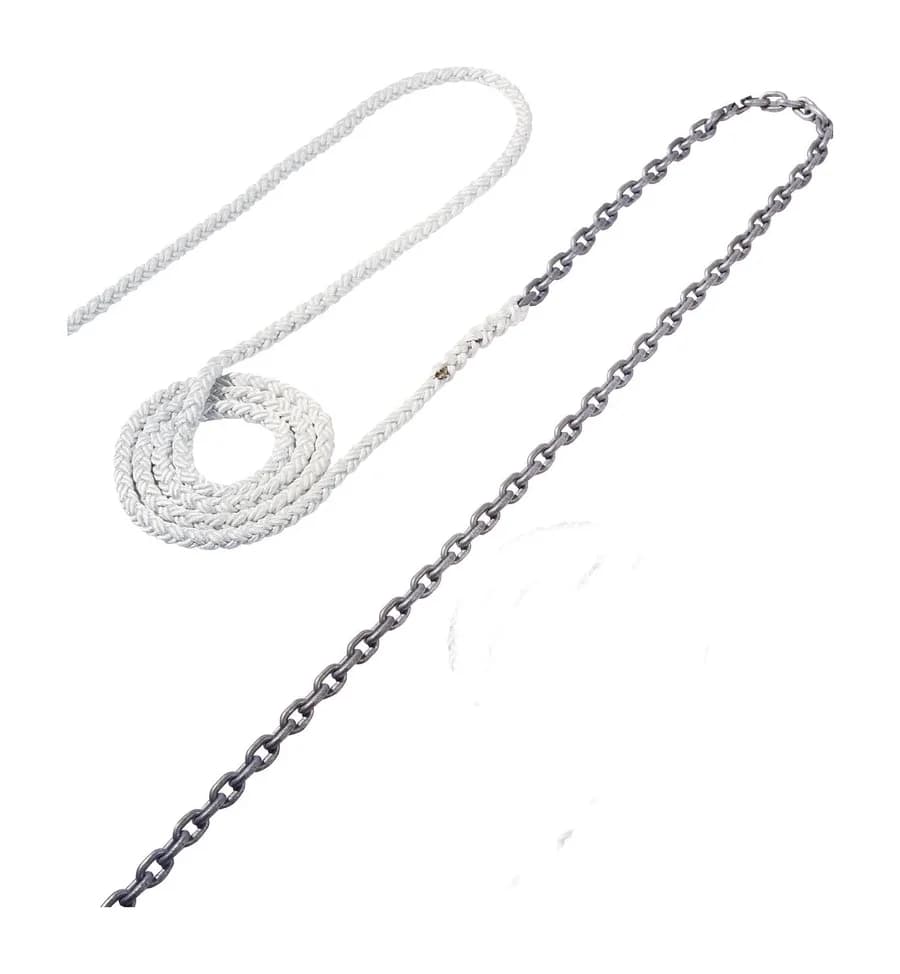
Luxfords sells chain and rope by the metre, so you carry exactly what your cruising grounds demand — if the calculation says 15 m of chain and 55 m of nylon, that's what we'll cut and splice. Prefer ready-made? Maxwell's pre-spliced kits pair 8-plait nylon back-spliced to calibrated short-link chain in standard combinations that feed perfectly through Wave Design™ chainwheels.
- Chain and 8-plait nylon cut to any length, professionally spliced
- Pairings: 6 mm chain + 12 mm rope · 8 mm + 14 mm · 10 mm + 16 mm
- Pre-spliced Maxwell kits: 10/20 m chain with 50–200 m rope
- Chain-only rodes and superyacht hawsers to order
Chain & rode FAQs
How much anchor rode should I carry?
Carry enough for your deepest realistic anchorage at proper scope, plus margin. Work it out as scope × (maximum depth at high tide + bow height). Anchoring in up to 10 m of water with a 1.2 m bow at 5:1 all-chain scope means 56 m — so carry 60 m. For rope/chain at 7:1 the same spot wants around 80 m. Many Australian coastal cruisers settle on 60 m of chain or 10–20 m of chain plus 100 m of rope.
What scope ratio should I use?
For all-chain rodes: 3:1 for short calm-water stops, 5:1 for typical overnight anchoring, 7:1 or more when it's windy or exposed. Rope/chain rodes need roughly two ratios more (5:1, 7:1, up to 10:1) because rope lacks the chain's catenary weight. The ratio applies to depth at high tide plus your bow roller height — and beyond about 8:1 extra scope adds little.
What does 'short link' chain mean, and why does it matter?
Windlass chainwheels are machined to grip a precise link geometry — short-link chain to DIN766 (or equivalent) has compact links that seat correctly in the pockets. Long or regular link chain will jump and jam in an anchor windlass and must not be used. Grades also matter: calibrated short-link chain should always be used, and Maxwell supplies chainwheels to fit just about every known chain on the international market.
Stainless or galvanised chain?
Hot-dip galvanised short-link chain is the workhorse: strong, economical, and easily re-galvanised after years of service. Stainless (AISI 316) costs more but runs cleaner through the gypsy, doesn't shed rust stains on white gelcoat and looks superb on a polished foredeck. Holding performance is equivalent — it's a budget and aesthetics call.
Can I mix chain sizes or extend my existing chain?
Avoid it. The chainwheel matches one calibrated size, and joining links create weak points and jamming risks at the gypsy. If you need more rode, replace the chain at the correct length, or convert to a rope/chain rode with a proper back splice — we can supply pre-spliced kits to suit.
Get your rode sorted
Tell us your boat, windlass (or the one you're planning) and where you anchor — we'll quote chain, rope or a pre-spliced kit cut to length.
Luxfords is an authorised Maxwell distributor — we size the complete system (windlass, anchor, chain, rope, stopper and controls), supply genuine parts and back it with Maxwell's three-year leisure warranty.
(03) 5973 6444