
Steering troubleshooting & bleeding
Hydraulic steering is honest — every symptom points somewhere specific, and nearly all of them point at air, oil or dirt. This guide follows Hydrive's own manual, with the traps called out.
The fluid rules - non-negotiable
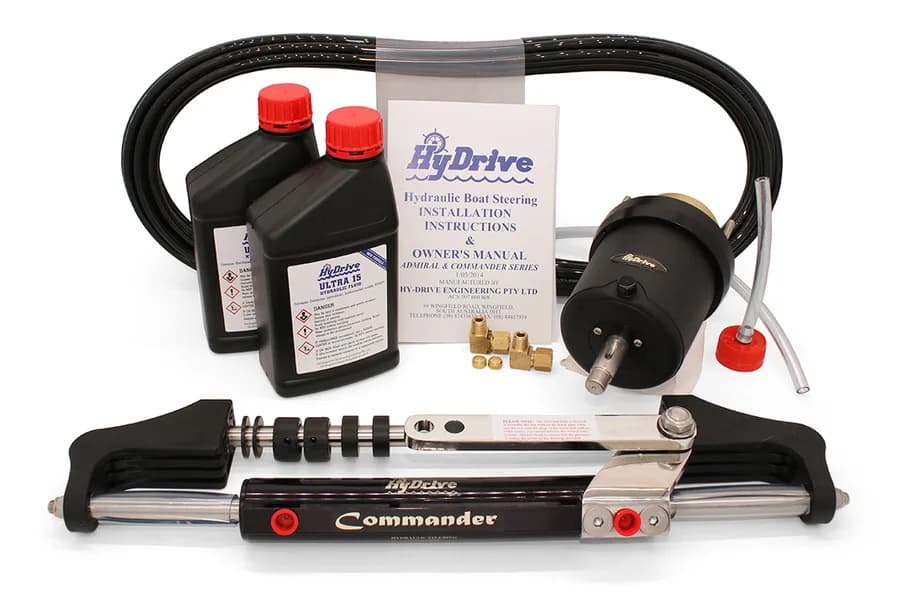
- Hydrive ULTRA-15 hydraulic oil only — other fluids risk premature seal wear and void the warranty
- Never automatic transmission fluid; never brake fluid (it damages seals and components)
- Don't mix different oils in the unit
- Allow about 2 L for filling and bleeding a single-station system, ~5 L for dual station
- Set the helm oil level ~12 mm below the filler thread — room for thermal expansion
- Thread sealant: Loctite, never Teflon tape — tape shreds into the system and can jam valves
Symptom → cause → fix
| Symptom | Likely cause | Fix |
|---|---|---|
| Spongy / lumpy wheel | Air in the system | Check all joints, re-bleed. Persistent air = a fitting drawing air without leaking oil. |
| Heavy / tight steering | Air, wrong (1000 psi) tubing, or mechanical binding | Re-bleed; verify tubing is the rated 2500 psi grade; disconnect cylinder and check the rudder/engine moves freely by hand. |
| Wheel slips — turns without moving the engine | Dirt in the helm pickup valves | Re-bleed with clean oil to flush; service the helm if it persists. |
| Slow response both directions | Worn cylinder piston seal | Fit the seal kit for your cylinder — replaceable in place on the boat. |
| Oil weeping from the helm | Overfilled, or trapped air expanding | Set level 12 mm below the filler thread; re-bleed. Extreme climates with long lines may need the expansion tank kit. |
| More than ~5° free play at the wheel | Air still in the system (lock valves can't seat) | Re-bleed both sides — free play between wheel and cylinder should be only about 5 degrees. |
| Catamaran engines drift out of sync | Leaking piston seal in the fluid link | Replace the seals on both cylinders, then re-synchronise via the ball valve. |
Bleeding, in outline
The single-station sequence from Hydrive's manual: fill the helm slowly, fit the inverted bleeder bottle to the filler, open one cylinder bleeder two full turns (never remove the screw), and wind the wheel towards that side at one turn per second or faster — Hydrive is explicit: do not bleed slowly — topping the bottle up as you go. When oil flows steadily, close it, swap to the other bleeder and reverse the wheel. Repeat both sides until the air is gone.
The pass mark: free play between wheel and cylinder of only about 5 degrees. More than that means air is still hiding — and if correct bleeding never quite gets there, stop bleeding and start looking for the fitting that's drawing air.
Dual stations bleed lower helm first with a solid cap on the upper; catamaran fluid-link systems have their own sequence and re-synchronising step. The full procedure ships in every kit — or call us and we'll talk it through.
The tubing trap:not all black nylon tubing is rated 2500 psi. The common 1000 psi tube looks identical — and Hydrive's manual calls it dangerous and says to remove it from the boat immediately. If your system came with unknown tubing, check before it lets go.
Sailboats:nylon tubing must not be used on sailboats at all — copper, steel or stainless lines are required. Sail systems also suit Hydrive's feedback helms, which keep the rudder feel sailors want.
Troubleshooting FAQs
Why does my hydraulic steering feel spongy or lumpy?
Air in the system, almost every time — Hydrive's manual calls it the most common complaint. Check every joint and re-bleed. The sneaky cause: a fitting can draw in air without leaking any oil, so a system that keeps getting spongy after correct bleeding has a fitting problem, not a bleeding problem. On outboards on the trailer, a slightly notchy feel can be normal (the rubber tiller mount) and disappears under way.
The wheel turns but the engine doesn't move - what's wrong?
Steering slip means the helm's pickup valves aren't sealing — usually dirt. Re-bleeding with clean oil often flushes it through; if not, the helm needs servicing. If the response is equally slow in both directions instead, suspect a worn cylinder piston seal — seal kits are available for every model, and Hydrive's instructions let you replace seals without removing the helm or cylinder from the boat.
What fluid do I top up with?
Hydrive ULTRA-15 only. The manual is blunt: other fluids can cause premature seal wear and void the warranty, ATF is prohibited, and brake fluid will damage seals and components. Don't mix oils. Set the helm level about 12 mm below the bottom of the filler thread — overfilling causes weeping as the oil warms and expands.
Why is the steering suddenly heavy?
Three suspects, in order: air in the system, the wrong tubing (common 1000 psi nylon tube looks identical to the rated 2500 psi tubing but stores pressure like a spring — Hydrive says to take it off the boat immediately), and mechanical binding. To isolate binding, disconnect the cylinder from the tiller or engine and move the rudder by hand — even large rudders should move freely in their bearings.
Need fluid, seals or a second opinion?
We stock ULTRA-15 and seal kits, and after 40+ years with Hydrive we've heard every symptom — describe yours and we'll point you at the fix or the part.